Changes in Consumer Spending Pattern
24 Jan, 2022
Category: Consumer
Tags: Portfolio
The spending pattern had changed after the pandemic. Here's a summary of the changes in the world's major countries. Due to the changes, the investing rationale is no longer the same.
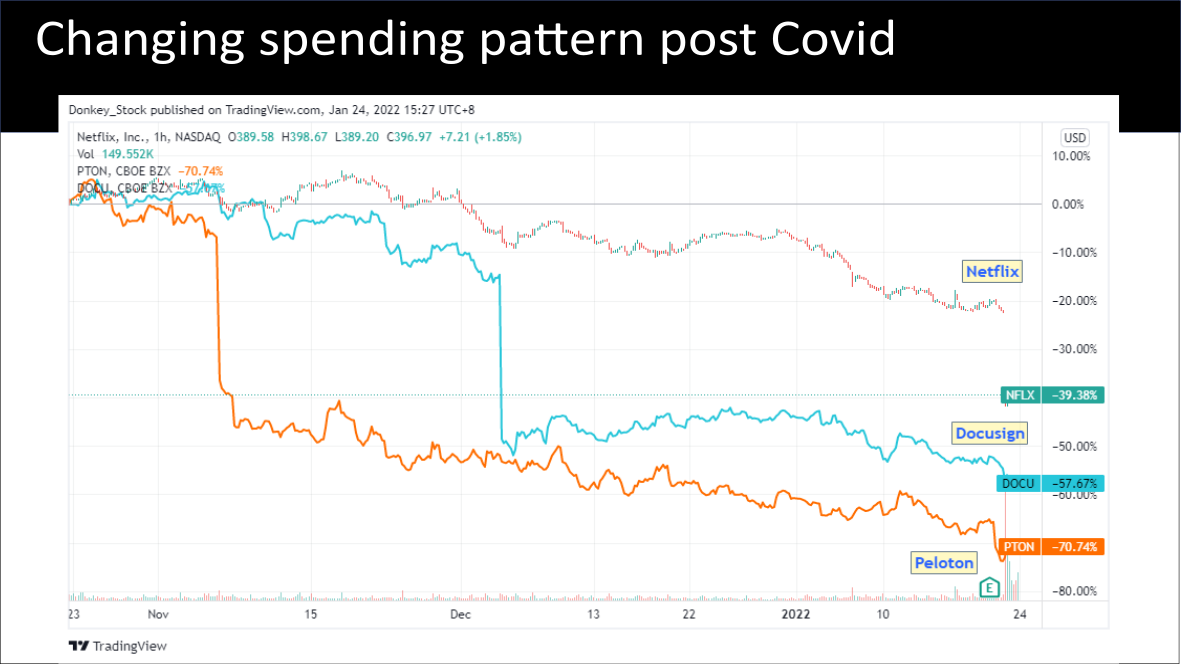
Netflix falls short of its projections for new subscribers
for the period Q4 2021, leading to a 20% plunge in Netflix’s share price. In
2021, there are 617.4 million Netflix viewers worldwide, making up 7.9% of the
population. We believe Netflix has reached the ceiling of this industry unless the global population grows faster or China opens up its market for foreign video
streaming companies.
Besides Netflix, Peloton and Docusign also experience a
sharp fall post-pandemic. Hence, we did some research to understand the
changing consumer behavior of a few major countries.
Singapore
Although green consumerism is still not a big movement in
Singapore, there is definitely a rising trend for it.
Singaporeans trading up to premium, luxury, or foreign
brands, as well as their desire for healthier lifestyles, improved image (i.e.
conspicuous consumption), and new experiences through their consumption habits.
India
The consumer group can literally be divided into three clear
groups:
1.
The first group comprises consumers who are
extremely brand conscious and depend upon the high-end retail stores to satisfy
their needs
2.
The second group is another extreme that satisfies
their consumer needs from outlets that do not hold popular brands and are also
much cheaper
3.
The third group however follows the middle path-
they satisfy their consumer needs either from high-end retail outlets or the
less popular retail outlets, as and when necessary.
The growing purchasing power and the rising influence of social media have enabled Indian consumers to splurge on good things.
The import of electronic goods is increasing and India is
expected to have 829 million smartphone users by 2022.
China
A growing number of people from China’s middle class — and
those who aspire to be middle-class — are spending the Spring Festival not only
eating, drinking, and visiting family, but also on leisure activities and other
immaterial forms of consumption.
Chinese consumer behavior seems to be a lot closer to
American consumerism where desiring the ‘good life’ is widely accepted and
higher levels of consumption are deemed beneficial to consumers.
China is the world’s top spender in tourism.
Affluent Chinese product consumers appear to have a
no-holds-barred approach to spending exorbitant sums on luxurious goods from
reputable brands or investing in items of significant value that they believe
can generate exponentially high returns in the future. One example is the
vast-expanding Chinese luxury market driven by the entry of conglomerates such
as LVMH, Pernod Ricard, and Richemont.
Vietnam
Digital networks and links facilitate exposure to their
interests, which create a matrix of consumer options. This demographic of
consumers will direct their purchases to cover basic needs – like food,
housing, and clothing – based on what they find online.
Education, Healthcare, F&B products, and Personal care
are key areas of expenditure.
Indonesia
The products and services, which Indonesian consumers spent
their money on, were grouped into five categories: Food, beverage, and tobacco;
Consumer foodservice; Travel; Household goods; and Clothing and footwear.
Thailand
Thai consumers particularly upper-income shoppers are
spending even more on experiences such as dining out and leisure travel as well
as on luxury products such as watches, jewelry, and smartphones.
Thai consumers are comfortable buying most things online,
except for jewelry, medicines, and perishable grocery items.
Japan
Retail sales and household spending data showed different
pictures of consumer spending, it’s safe to conclude that consumer spending
continues to gain strength only slowly, despite a very tight labor market.
Household spending fell as consumers spent less on
utilities, cars, domestic travel, and leisure.
Korea
South Korean consumers tend to be concerned with the brand
name and health attributes of a product.
Consumers are becoming less concerned with buying products
made in South Korea and are increasingly inclined to purchase non-domestic
products, often at much lower prices.
South Koreans are now on the brink of materialism and aspire
to lifestyles that are being portrayed by the media. They are increasingly
viewing money as the representation and sign of success and put greater
emphasis on publicly-visible items because of their attached symbolic meanings
and values.
Young South Korean consumers purchase apparel and other
fashion items which they can use to express their individuality amidst a
rather uniform society. They believe that they can express it using foreign
brands with scarcity value. Increasingly, South Koreans of all ages and genders
view their appearance as something that can be improved through ever
developing. Not being fashionable or not knowing the latest fashion trend is
considered negligent, ignorant, and tasteless.
UK
UK consumer spending is still declining despite the recent
pick-up in wage growth.
The data also confirms the structural shift in the retail
sector, from in-store sales to online shopping, and from spending on “stuff” to
expenditure on digital items.
Some people might choose to rebuild savings, rather than
spending more freely, especially if they felt less confident about the economic
outlook or their own circumstances.
Germany
Germans bought things like cars and other durable goods. The
growth in the purchase of food and beverage, tobacco, shoes, and clothing was
particularly strong. Despite the housing shortage in many German cities,
expenses toward apartments also saw an increase.
France
French consumers are particularly keen on services,
especially digital, cultural, and travel related. The number of French people
interested in sustainable development and responsible consumption is growing
rapidly, and today France offers the second biggest organic agriculture in the
European Union.
Consumers prefer products carefully packaged, creative and
appealing. The consumption of organic and fair trade products is on the rise.
Canada
An increasing number of senior couples report spending on
recreation and entertainment services which demonstrates their better finances
and health.
Canadian households' average expenditures are concentrated
in four main spending categories: personal taxes, shelter, transportation, and
food.
The highest rates of growth in household spending have
occurred in sectors such as health care and education and on some durable goods
(transportation, and household furnishings and equipment).
The wave of immigrants is influencing Canada’s consumer
profile and shopping habits. In particular, the trend is affecting food
shopping.
US
Certain spending avenues and methods are changing after the
pandemic ends. The American spends lesser shopping online and pick up, doing
less home improvement projects, and ordering less food for takeout or delivery.