Why a global internet infrastructure is doomed to fail?
14 Apr, 2020
Category: Technology
Tags: Internet
OneWeb is not the first company to fail in providing global high-speed internet. Here's some lesson learnt from this business model.
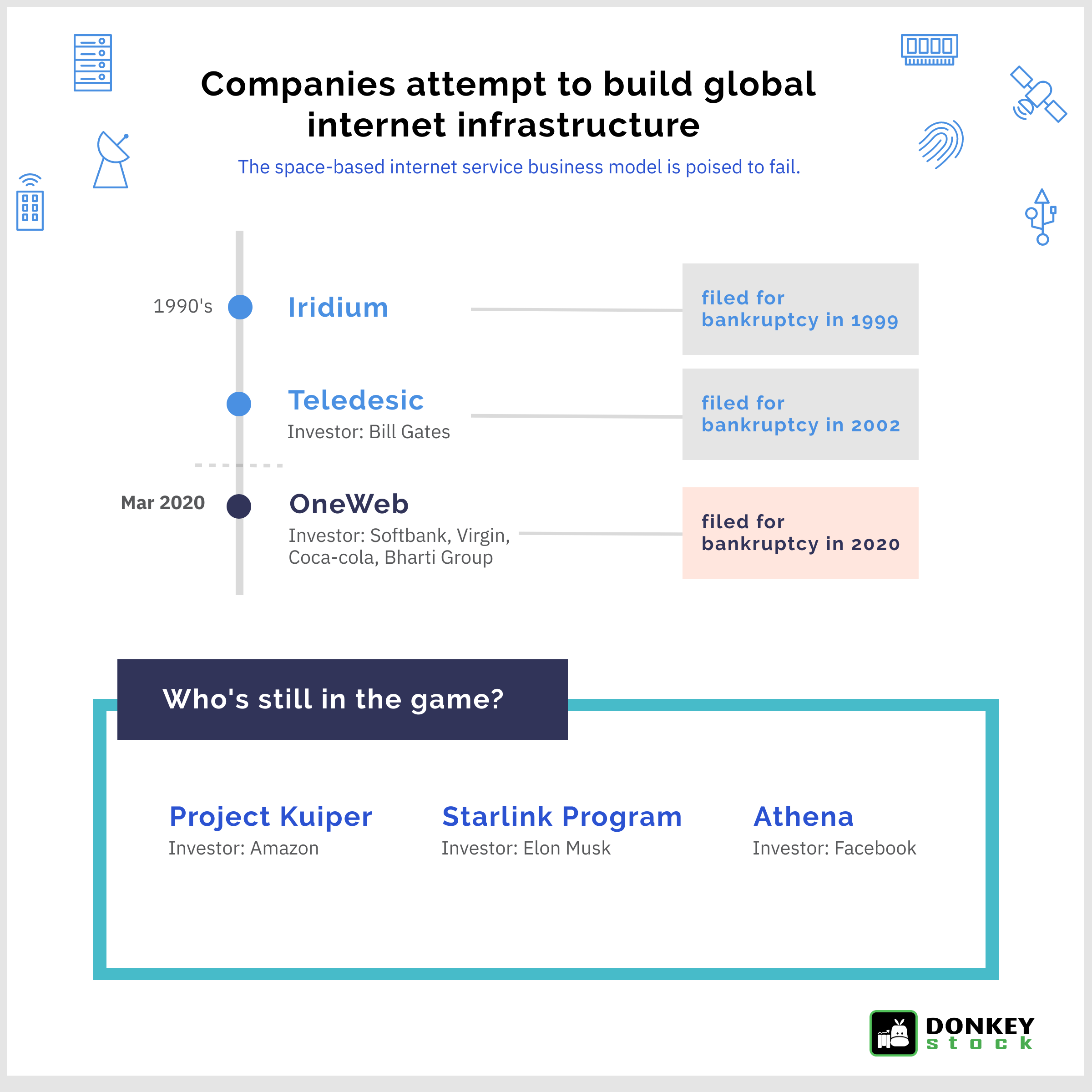
OneWeb was one of a handful of companies including SpaceX and Amazon that are racing to build giant constellations of high-speed internet satellites. OneWeb planned to operate a fleet of at least 650 satellites to blanket the entire Earth with broadband service and had raised nearly $3.5 billion from large investors like the Virgin Group, Qualcomm, Airbus and SoftBank. SoftBank is said to have invested about $1.9 billion in OneWeb and owned nearly 40% of its shares.
OneWeb suddenly declared bankruptcy on March 27, 2020, and has laid off 85% of its employees.
OneWeb is not the first company to fail in providing global high-speed internet. The main problem of this business model is that building and launching satellites is expensive, especially if you're launching hundreds or thousands of them. In the 1990s, several companies attempted to connect the world with satellite constellations before going bankrupt.
· Teledesic, a company backed by Bill Gates, wanted to beam broadband internet from orbit, but only launched a single satellite before filing for bankruptcy protection in 2002.
· Iridium managed to launch a constellation of 66 satellites to deliver cell service across the entire Earth but filed for bankruptcy in 1999 after it failed to attract enough customers to support its business.
Here's some lesson learned from this business model:
1. Large constellations are very capital intensive, and investors have to be extremely patient because the returns aren'tt going to be immediate.
2. Investors need to bear in mind that the Pareto principle (also known as the 80/20 rule) applies. This principle states that for many events, roughly 80% of the effects come from 20% of the causes. Same for a business, where 80% of the revenue is generated from 20% of its customers. Providing a global infrastructure enabling everyone to surf the web is a noble action but not everyone can afford to pay for this service and focusing on customers who have the ability to pay and willingness to pay is the core essence for every business.
Related Articles

Why Zoom can beat its peers
2023-08-09
|
Technology
|
Tags: Internet
One advantage that Zoom owns to become the leader in the video conferencing industry.
Semiconductor counters price outlook
2023-08-09
|
Technology
|
Tags:
|
Archived
Malaysia semiconductor stocks are charting new highs while its US counterparts are starting to fall.
Besides energy and grain, winners from Russia Ukraine conflict
2023-08-09
|
Technology
|
Tags: Cybersecurity
Proxy to war and long-lasting demand for cybersecurity