Value Trap
Value traps are investments that are trading at such low levels and present as buying opportunities for investors but are actually misleading.
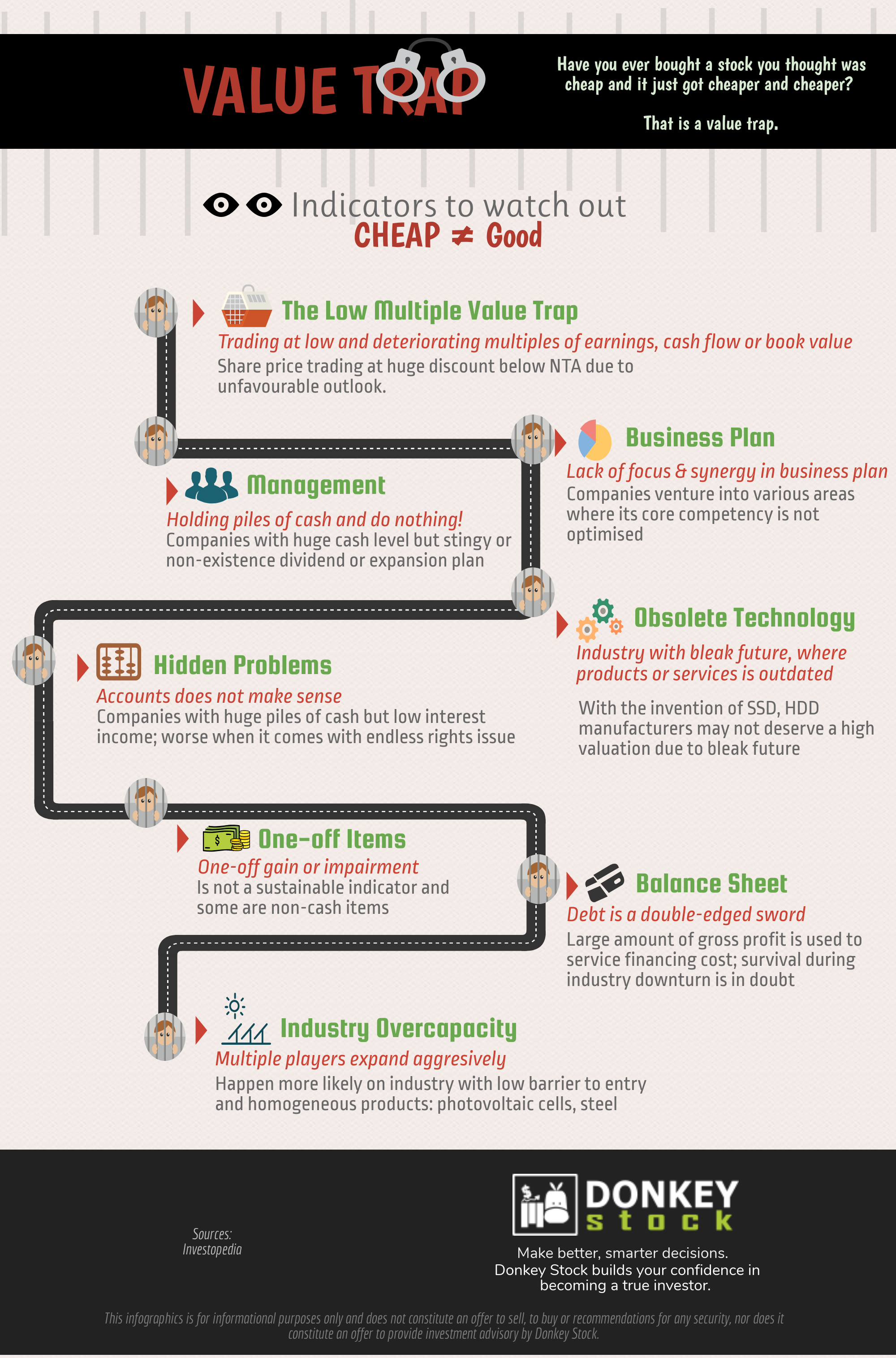
Have you ever bought a stock you thought was cheap and it just got cheaper and cheaper? That is a value trap. It appears to be but, in reality, something has changed and the lower price is discounting or warning of deterioration or change ahead.
Business Plan
Beware of a business plan that is not understandable or is unprofitable. If a company is unable to make profits or has a plan that is complicated and hard to explain – avoid it. Some companies have ventured into plantation, oil and gas, property, construction, where lack of focus is seen and synergy is not seen among the industries the management ventured into.
Obsolete Technology
If a product or service is outdated, it will most likely fail. In an industry with bleak prospects, eg HDD, SSD, all HDD manufacturers may not deserve a high valuation.
Management
Quality management will give trustworthy guidance and demonstrate they have the knowledge to successfully guide the company.
If management is selling stock, holding a pile of cash with no expansion plan, no debt obligation, and no dividend payout. Management receives high directors remuneration. These would be signs of a possible value trap.
Companies where cash level > market cap, but stingy or non-existence dividend.
Accounting
Producing complicated or fraudulent company accounting reports often means there are additional hidden problems. Eg: Companies with huge cash holding but its interest income is proportionally low and management is asking for a rights issue to raise cash.
Balance Sheet
High debt can cause problems with liquidity and solvency that can sink an otherwise good business plan. A strong balance sheet is the foundation of a quality company and provides a margin of safety. When a company faces adverse conditions a conservative capital structure gives them the financial flexibility to meet the challenges.
Eg: Companies that raise huge debt to venture into new industries might face a huge problem when the industry turns down. Some companies have low net profit due to a large amount of gross profit is used to serve financing costs.
Strategic Advantages
A company that lacks strategic advantages to overcome tough competition or heavy regulations can lose its ability to compete. Before purchasing a cheap stock be sure the company has competitive advantages that will provide the cash flow and growth needed to raise the price of the stock.
Market leaders, have economies of scale, pricing power, differentiation of products, cost benefits, or have powerful brands.
One-off item
Some companies may one-off gain or one-off impairment loss recorded in the past income statements.
Cyclical Industry
Some business operates in a cyclical industry where current earnings are not sustainable in the near future. The market has factored in the decreasing profit in the future, leading to a lower price willing to be paid by investors.
Industry overcapacity
An industry where multiple players are aggressively expanding their capacity in order to cut down their production cost and capture a larger market share. However, an overcapacity situation is often seen after their capacity expansion phase. A low barrier to enter this industry and industry producing homogenous items will worsen the situation. Eg: Photovoltaic cell, steel
Related Guides
Mental for Value Investing
2022-01-18
|
Guide
|
Tags: Portfolio
Value investing is an investment strategy that involves picking stocks that appear to be trading for less than their intrinsic or book value.

Types of yield curve and its impact to the market
2021-11-26
|
Guide
|
Tags: Portfolio
Yield Curve is a graph that shows how bond yields and maturities are related. Here are the types of the yield curve, factors affecting the yield curve and how the market interpret the different type of yield curve

Types of Coal
2021-11-25
|
Guide
|
Tags: Portfolio
Coal is an abundant natural resource that can be used as a source of energy and is primarily used as fuel to generate electric power. The article illustrates the major types or ranks of coal